
Exploring our Industrial Heritage: Harley Davidson
The Harley-Davidson Powertrain Factory Tour in Menomonee Falls, Wisconsin, offers visitors an inside look at how Harley-Davidson engines and powertrain components are manufactured. The tour provides a fascinating view of modern manufacturing processes while highlighting the craftsmanship associated with the Harley-Davidson brand. Visitors see firsthand the machining operations, engine-component production, assembly processes, quality inspections, and other steps involved in transforming raw materials into finished powertrain components. One of the most interesting aspects is seeing how advanced computer-controlled equipment works alongside skilled manufacturing employees to produce precise engine parts.
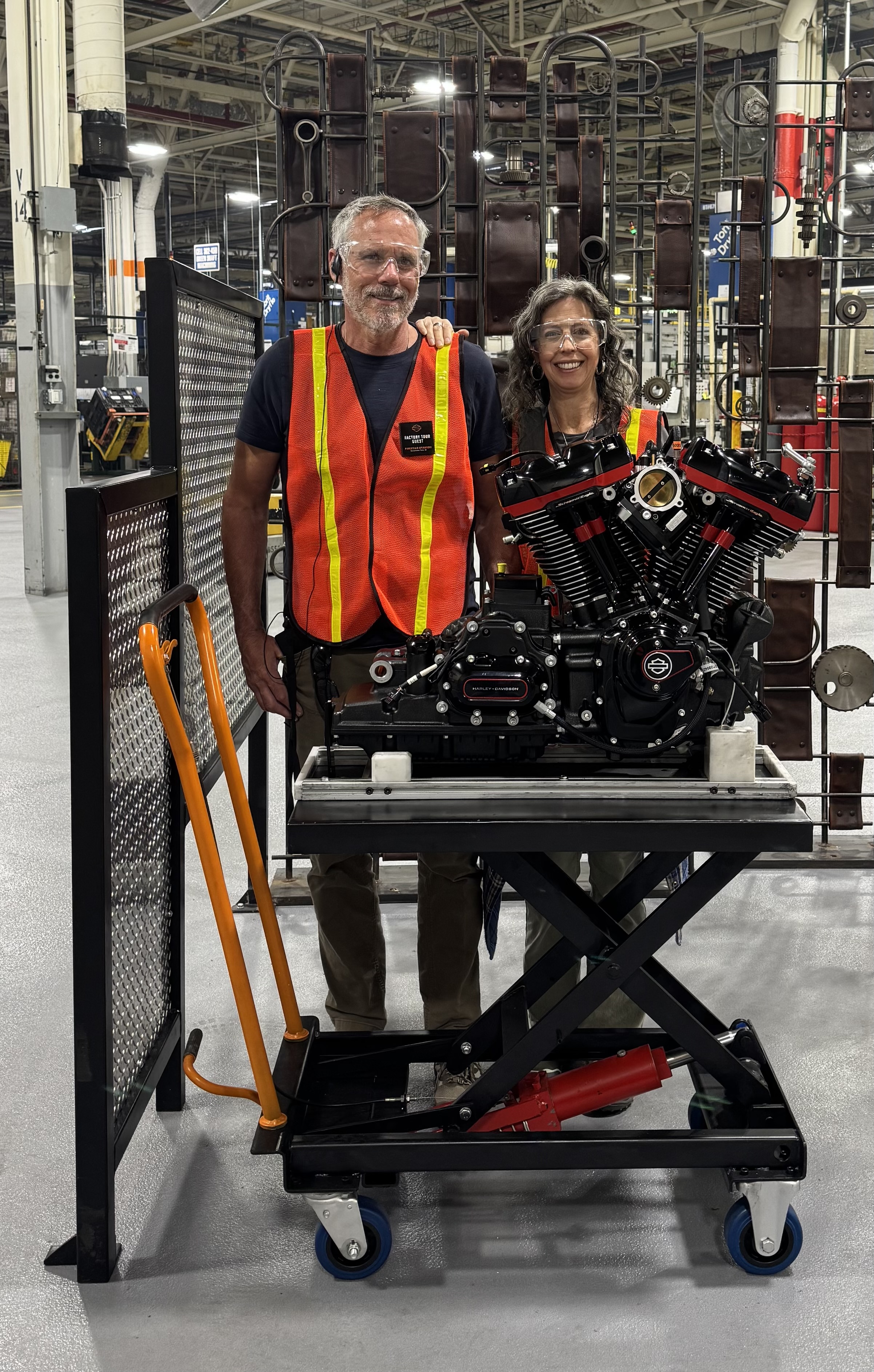
The tour also demonstrates the importance of quality control, standardized work, and careful inspection throughout the production process. Visitors gain a better appreciation for the complexity involved in building motorcycle engines and the coordination required to maintain consistent quality and production efficiency. For manufacturing enthusiasts like me, the tour provides an excellent opportunity to see American manufacturing technology, skilled labor, and Harley-Davidson's engineering heritage working together on a production floor.
Harley History
Harley-Davidson was founded in 1903 in Milwaukee, Wisconsin, by William S. Harley and brothers William, Arthur, and Walter Davidson. What began as a small motorcycle operation in a backyard workshop grew into one of the world's most recognizable motorcycle companies. The early company focused on building reliable motorcycles that could handle America's developing roads and demanding conditions. Harley-Davidson expanded rapidly during the early twentieth century and became an important supplier of motorcycles to the U.S. military during both World Wars, helping establish its reputation for durability and performance. During the postwar years, Harley-Davidson became closely associated with American motorcycle culture, independence, adventure, and the open road.
Harley-Davidson experienced a difficult period during the 1960s and 1970s as competition from Japanese motorcycle manufacturers grew rapidly. Companies such as Honda, Yamaha, Suzuki, and Kawasaki offered reliable motorcycles at competitive prices, challenging Harley-Davidson's traditional market. Quality problems, financial difficulties, and changing consumer preferences added to the company's struggles. In 1969, Harley-Davidson was acquired by AMF, but production pressures and quality concerns continued. By the early 1980s, the company was in serious trouble. A group of Harley-Davidson executives eventually purchased the company back from AMF in 1981 and began rebuilding it through improved quality, manufacturing processes, and stronger management.
Harley-Davidson became publicly traded again in 1986 and continued expanding its motorcycle lineup and international presence. Its distinctive V-twin engines, traditional styling, and strong owner community became central to the company's identity. Today, Harley-Davidson remains an iconic American motorcycle manufacturer, producing motorcycles designed for touring, cruising, adventure, and performance. Beyond motorcycles, the company has built a powerful lifestyle brand through clothing, accessories, dealerships, events, and rider communities. Its long history demonstrates how manufacturing heritage, product identity, and customer loyalty can combine to create one of America's most enduring industrial brands.
My Tour Experience
 Walking into the Harley-Davidson Powertrain Factory, I immediately felt like I was about to see the mechanical side of one of America's most famous motorcycle brands. I have always appreciated their motorcycles but seeing how a Harley-Davidson powertrain comes together bridged the processes to the brand for me. Instead of simply looking at finished motorcycles, I was able to see the machines, people, technology, and processes that create the mechanical heart of the motorcycle.
As I moved through the factory, I watched raw materials and individual components being transformed through precision machining, drilling, milling, grinding, and other manufacturing processes. Large computer-controlled machines were cutting and shaping metal with incredible accuracy, and it was fascinating to watch the equipment repeatedly perform the same operations while maintaining extremely tight tolerances.
What really caught my attention was how much technology was involved. These weren't just big machines making parts; they were sophisticated manufacturing systems requiring skilled employees to monitor performance, inspect components, maintain equipment, and solve problems. The factory was heavily invested in robotics. Machine loading and unloading and product conveyance was almost exclusively controlled by automation and robotics.
I found myself thinking about how important maintenance must be in an operation like this. A machine that goes down at the wrong time can affect the entire production flow, so reliability, preventive maintenance, and quick problem-solving are clearly critical. As the tour continued, I saw how individual components eventually moved toward assembly. Gears, shafts, bearings, pistons, cylinders, fasteners, and other parts were brought together in a carefully controlled sequence. Watching all those individual pieces become a complete powertrain in the assembly cell was probably one of the most interesting parts of the tour. It gave me a much better appreciation for how much work is hidden behind the finished motorcycle.
Lean Assembly
The assembly cell uses a significant amount of automation but also employs a fair amount of skilled labor. It is clear to see the foundation of lean manufacturing best practices as the cell is time-balanced to maintain a steady flow of product without the cost of idle work time. Visual controls throughout the plant, are a good indication of Leans deep roots there.
A VERY FUN FACT is the Harley uses an “And-On” system to call resources to address issues. The “And-On” system was initially developed by Toyota, but Harley put a fun spin on the concept. When an assembly line worker needs a specific resource, they push the button to call that specific resource. So, for example, we I was touring, an employee needed the support of an engineer and so they pushed the “Engineer” button. When they did, Crazy Train by Ozzy Osborne would play over the loudspeaker and that song notified the Engineering Department that they needed to pay a visit to that specific workstation. Pretty cool – right?!
Quality, Quality, Quality
I also appreciated the emphasis on quality considering the importance of rider safety and since my father-in-law is a Harley rider, the quality focus took on a personal note. Components cannot simply look good; they have to meet precise engineering specifications. Employees use inspection equipment and standardized processes to make sure parts are correct before they move forward. The final testing process was especially interesting because this is where all the machining, assembly, inspection, and engineering work comes together. Seeing the powertrain being tested made it easier for me to understand the connection between manufacturing precision and the performance riders expect when they finally get on the road.
The Legendary Motorcycle Comes to Life at the Factory
What made the tour fun for me was the contrast between Harley-Davidson's traditional image and the modern manufacturing technology behind it. When I think about Harley-Davidson, I think about chrome, leather, open highways, and the unmistakable sound of a V-twin engine. The factory showed me another side of the brand—the engineering, precision, teamwork, maintenance, and manufacturing discipline required to create that experience.
Harley-Davidson's legendary image may be built around chrome, steel, roaring engines, and the open road, but behind that image is a highly sophisticated manufacturing operation. Every finished powertrain represents countless machining operations, measurements, inspections, adjustments, assembly steps, and quality decisions. It also represents the work of maintenance technicians, engineers, machine operators, quality professionals, material handlers, and production leaders who must work together to keep the factory running. When the finished motorcycle finally fires up and produces that unmistakable Harley-Davidson sound, it is easy to think about the engine simply as a powerful machine. In reality, that powertrain is the final product of an extraordinary manufacturing journey—from raw metal to precision-machined components, from individual parts to carefully assembled systems, and finally from a factory production line to the open road. That combination of technology, craftsmanship, teamwork, and mechanical attitude is what makes a Harley-Davidson powertrain more than just an engine—it is the heartbeat of the motorcycle.
For anyone who enjoys motorcycles, manufacturing, or simply seeing how things are made, I found the Harley-Davidson Powertrain Factory Tour to be a fascinating and genuinely fun experience. I left the tour with a completely different appreciation for what goes into a Harley-Davidson motorcycle.
Stay connected with news and updates!
If you want some weekly T4T wisdom coming straight to your inbox for your reading pleasure - look no further! Join our mailing list to receive the latest blogs and updates.
Don't worry, your information will not be shared.
We hate SPAM. We will never sell your information, for any reason.
