
AI in Manufacturing: Employee Training

As an OpEx Manager supporting the implementation of Lean Manufacturing and Six-Sigma in factories across the globe, I did my fair share of work as a trainer. Creating content and keeping it fresh took a fair amount of work. Also, exploring various industries to identify manufacturing best practices was difficult. Good information was hard to uncover. Knowing now, what I didn't know then, I wish I had the advantage of AI to support my efforts. It could have made my job more efficient and it would have improved my training material and teaching methods.
Artificial intelligence (AI) is rapidly transforming the way manufacturing companies design, deliver, and evaluate employee training. Traditionally, manufacturing training programs have relied on static materials such as printed manuals, slide presentations, and classroom lectures—approaches that can be time-consuming to update, inconsistent in delivery, and not easily tailored to individual learning needs. With the integration of AI, however, organizations can revolutionize their workforce development efforts by creating adaptive, engaging, and data-driven training ecosystems. AI not only streamlines the development of high-quality learning materials but also personalizes training experiences, enhances interactivity, and provides measurable insights into employee knowledge and performance.
Creating Training Material
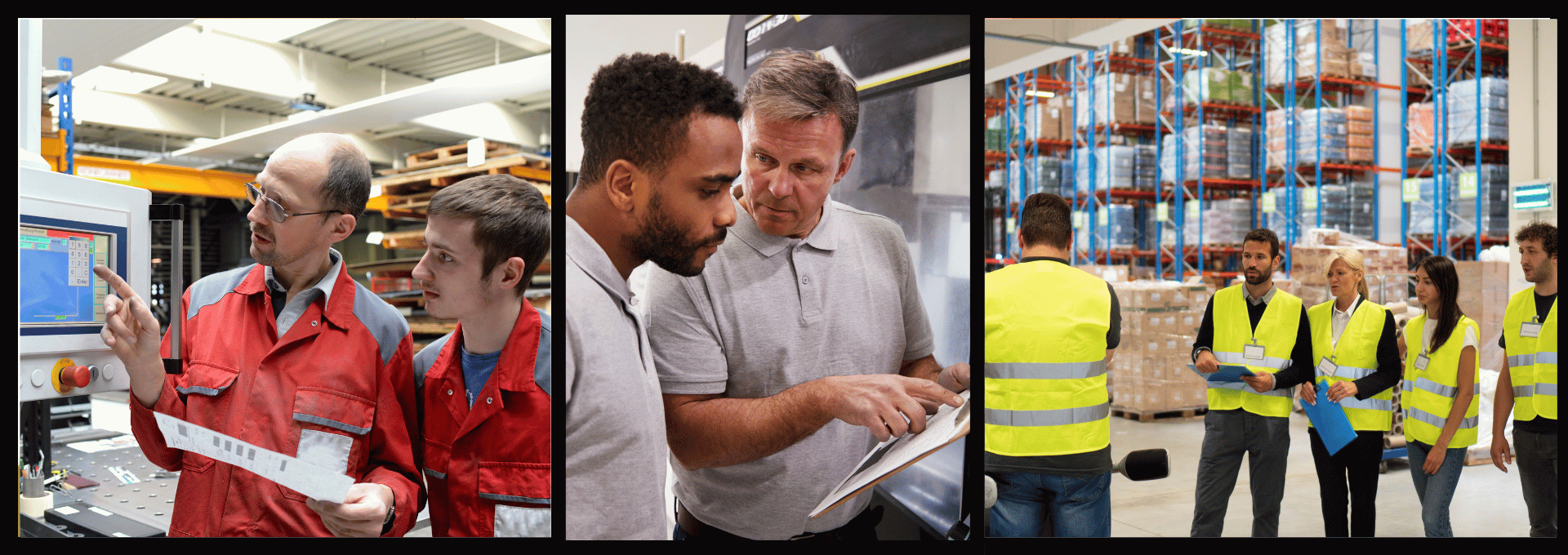
One of the most significant advantages of AI in training development is its ability to generate content quickly and efficiently. Using natural language processing (NLP) and generative AI tools, manufacturing leaders and training coordinators can create detailed instructional materials—such as operation guides, maintenance procedures, safety protocols, and troubleshooting steps—based on existing documentation or expert input. Instead of manually authoring and formatting training modules, AI can automatically convert written procedures or engineering documents into well-structured training guides, videos, or e-learning modules. For example, an AI system can analyze a machine’s operation manual and generate step-by-step visual instructions with images or animations illustrating each task. This capability ensures that information is both accurate and visually engaging, making complex concepts easier to understand for operators, maintenance technicians, and supervisors alike.
Personalized Customization
AI also plays a vital role in personalizing training to fit the individual needs of manufacturing employees. In a diverse workforce, employees often possess varying skill levels, learning speeds, and prior experiences. Traditional training programs struggle to accommodate these differences, resulting in some employees being undertrained and others disengaged due to repetitive material. AI-driven learning management systems (LMS) use data analytics and adaptive algorithms to tailor content to each learner’s progress and performance. For instance, if a new operator demonstrates proficiency in safety procedures but struggles with machine setup, the AI system can automatically adjust future lessons to focus more on setup training while minimizing redundant safety content. This personalization helps employees learn efficiently, stay engaged, and retain knowledge longer. Furthermore, AI can provide real-time feedback and reinforcement, guiding employees through practical exercises until they achieve mastery. This approach ensures that every learner, regardless of their starting point, develops the skills necessary for success on the production floor.
Interactive Exercises
Beyond content creation and personalization, AI enhances interactivity in training programs—turning passive learning into active engagement. In manufacturing environments, hands-on experience is crucial, yet traditional training may be limited by equipment availability, safety risks, or production schedules. AI-powered simulations and virtual reality (VR) training environments allow employees to practice complex or hazardous procedures in a safe, controlled digital space. For example, a welding trainee can use an AI-driven VR simulator to practice welding techniques while receiving real-time feedback on torch angle, speed, and accuracy. Similarly, machine operators can learn how to identify faults or perform maintenance tasks without taking actual equipment offline. These immersive experiences bridge the gap between theory and practice, enabling workers to gain confidence and competence before applying their skills in real-world conditions.
AI-driven interactivity can also extend beyond virtual environments into augmented reality (AR) applications. Using AR headsets or tablets, employees can receive AI-generated step-by-step guidance overlaid onto real-world equipment. For example, during machine setup or inspection, an AR system can highlight components, show torque specifications, and alert the user to common errors—all powered by AI recognition of visual data. This technology transforms traditional on-the-job training into an interactive learning experience where employees learn by doing, supported by intelligent, context-aware assistance.
Demonstrating Competence
Testing and evaluating employee knowledge is another area where AI delivers substantial improvements over conventional methods. Traditional assessments, such as paper-based tests or one-size-fits-all quizzes, often fail to measure practical skills or provide meaningful feedback. AI-based assessment tools can dynamically generate tests that adjust in difficulty based on the learner’s responses, providing a more accurate measure of understanding. For instance, if an employee consistently answers basic questions correctly, the system can present more complex, scenario-based questions to challenge their problem-solving skills. Additionally, AI can analyze test data to identify knowledge gaps across the workforce, helping training managers pinpoint where additional instruction or coaching is needed. Machine learning algorithms can even correlate assessment results with on-the-job performance metrics, allowing companies to verify that training is truly improving productivity, quality, and safety outcomes.
Identifying Training Needs
Another powerful application of AI in manufacturing training is its ability to analyze data from the shop floor and use it to inform future training needs. By integrating AI with production monitoring systems, organizations can identify patterns in machine downtime, defect rates, or safety incidents that indicate skill deficiencies. For example, if a particular assembly line frequently experiences errors related to equipment calibration, AI can flag this trend and automatically recommend refresher training for the operators involved. This proactive approach ensures that training remains relevant, timely, and directly linked to operational performance. Over time, AI-driven analytics help build a culture of continuous improvement, where learning is directly aligned with measurable business goals.
Language and communication barriers, common in many global manufacturing environments, can also be mitigated with AI. Real-time translation tools and voice recognition systems can help non-native speakers understand training materials and instructions in their preferred language. AI can generate multilingual content automatically, ensuring that all employees receive consistent, accurate information regardless of language background. This inclusivity not only enhances learning outcomes but also promotes a safer and more collaborative workplace culture.
Speedy Administrative Work
AI can further assist trainers and managers by automating administrative and tracking tasks. Learning management systems enhanced with AI can monitor employee progress, track certifications, and send reminders for mandatory retraining sessions or safety updates. These systems can generate detailed reports that summarize individual and team performance, making it easier for management to evaluate training effectiveness and compliance with regulatory standards. Moreover, AI chatbots or virtual assistants can provide employees with 24/7 access to training resources and answer common questions about procedures or safety rules. This on-demand support reduces downtime and empowers workers to solve problems independently.
The integration of AI into training also promotes scalability and cost efficiency. Manufacturing companies often face the challenge of training large, geographically dispersed workforces while minimizing disruption to production. AI-driven training programs can be deployed across multiple facilities simultaneously and updated in real time as processes or equipment change. Instead of retraining instructors or reprinting manuals, updates can be automatically pushed through digital platforms, ensuring consistency and accuracy across the organization. This agility helps manufacturers stay competitive in fast-changing industries where new technologies and processes are constantly being introduced.
Not the Trainer's Adversary

While AI offers tremendous benefits, successful implementation requires thoughtful planning and a balance between technology and human expertise. AI should complement, not replace, the role of experienced trainers and mentors who provide context, motivation, and hands-on guidance. The best results occur when AI systems are used to handle repetitive or data-driven tasks, freeing human trainers to focus on higher-level teaching, coaching, and relationship-building with employees. Additionally, companies must prioritize data privacy, ethical use of AI, and transparent communication with employees to build trust in the new systems.
In summary, AI is reshaping how manufacturing organizations train, engage, and assess their employees. By automating content creation, personalizing learning paths, enabling interactive simulations, and providing real-time performance insights, AI empowers companies to develop a more skilled, adaptable, and safety-conscious workforce. The combination of smart technology and human leadership creates a training ecosystem that is efficient, scalable, and continuously improving. In an era where technological change is constant, leveraging AI for employee training ensures that manufacturing workers remain not only competent but also confident and future-ready—driving productivity, innovation, and excellence on the factory floor.
Read more about AI applications for your factory:
AI in Manufacturing: Procedure Writing
AI in Manufacturing: Predictive Maintenance
Stay connected with news and updates!
If you want some weekly T4T wisdom coming straight to your inbox for your reading pleasure - look no further! Join our mailing list to receive the latest blogs and updates.
Don't worry, your information will not be shared.
We hate SPAM. We will never sell your information, for any reason.
